-
May 2026
- May 28, 2026 Index May 28, 2026
- May 28, 2026 Human Made Symbol May 28, 2026
- May 15, 2026 How to Choose a Wine Label Designer (If You Actually Care About Selling Wine) May 15, 2026
- May 2, 2026 Why AI is a sh*tty critic May 2, 2026
-
January 2026
- Jan 20, 2026 Portfolio Strategy Jan 20, 2026
- Jan 20, 2026 What we do — Mason Vineyard Case Brief Jan 20, 2026
- Jan 16, 2026 Emotional Value Jan 16, 2026
-
January 2019
- Jan 13, 2019 Know your emotional product Jan 13, 2019
- Jan 13, 2019 How to not fail — understand Brand Jan 13, 2019
- Jan 13, 2019 Your retail sucks — how-to fix it Jan 13, 2019
- Jan 13, 2019 Is your Emotional Product Score helping or hurting you? Jan 13, 2019
Human Made Symbol
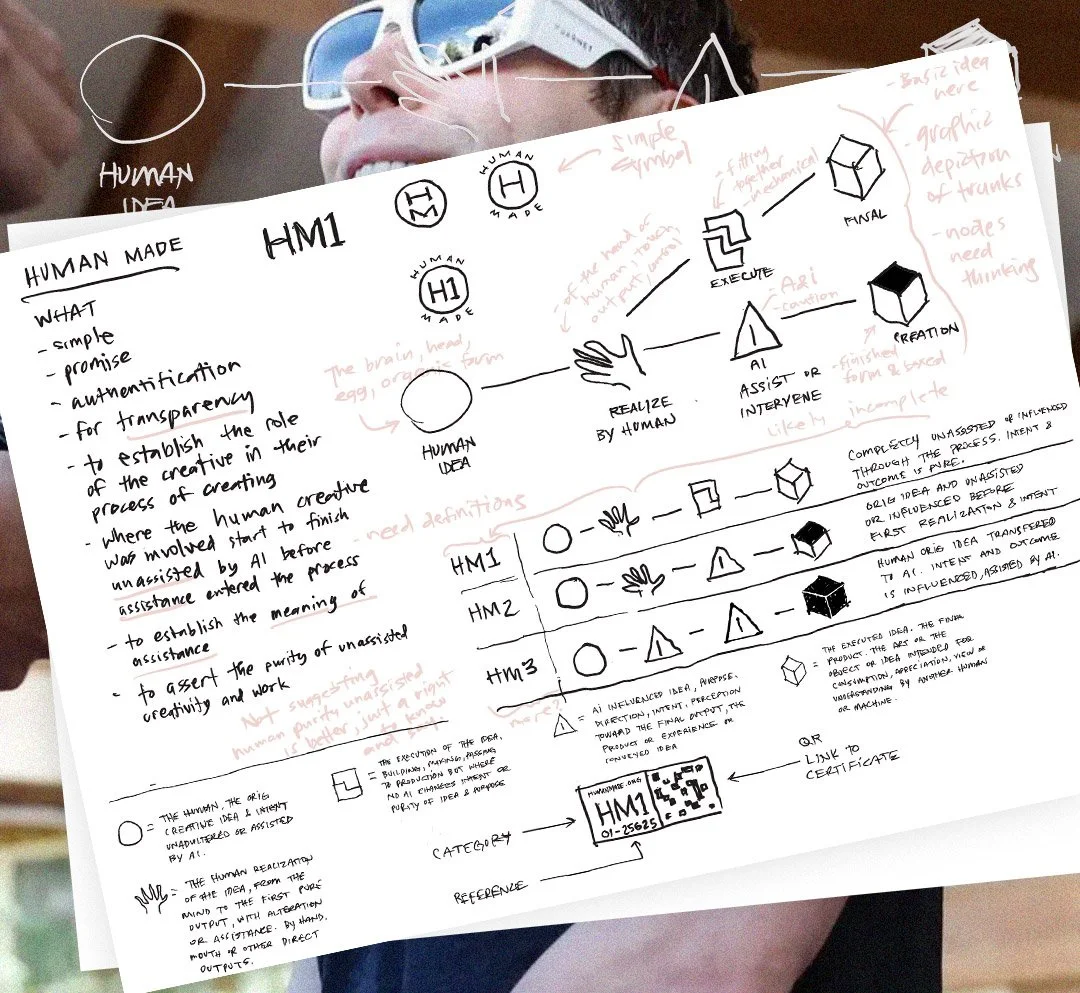
The world needs transparency
In case people haven’t noticed, the Insite team is pretty passionately behind the ideas of craft, transparency, honesty, authenticity and other deeply human aspects of making — whether that be art, design or products in general. And to encourage and envelop these ideas, we’ve built our brand business to support these concepts and show brands how they can pursue craft in everything they do. We help our clients build craft brands that are honest, transparent and passionate and as a result we’re known Nationally in Canada as the Craft Brand experts.
So it makes sense that we think about this area of brand thinking a lot. Consequently, a couple years ago while sketching, I was thinking about the potential impacts of emerging AI technology on art, design and craft and the resulting importance of trust and transparency in the creative product. I felt strongly that the idea of honesty is vulnerable and being undermined — and that there would be a time when honest human creativity would need to be more overt in terms of originality and ownership. With that I considered and doodled a system of identification called “Human Made" which I pondered if it would ever become a necessity in our creative lives to include in our representation of the work we create. I believe we’re now there. Desperately.
The Human Made Identification System
HumanMade [HM]. A symbol and certification that attempts to guarantee the integrity of what you create in the world — like a promise to the world that your creation is from your human mind, through your human hands and AI free tools, to the final finished form unaltered or influenced by AI. This could be [HM1].
And with honesty and clarity the HM symbol informs the world at what stage of the creative process you involved AI — be it not at all [HM1], or just at the final execution [HM2], or AI assisted at every point after concept [HM3]. And finally, a completely AI generated product without human conceptual influence [AI].
AI is an increasingly used tool in the creative process from thought to realization. And it’s not going away. One of the many areas AI seems to be conflicting with society, as it relates to creative, is in the lack of transparency of its involvement. Like certified Organic food or B Corp responsibility and sustainability, I believe that people want to know the truth in a product such as where AI has influenced creative.
This is for many reasons both emotional and practical. Naturally, we need to know for a human sense of morality and emotional value — some feeling the need to connect with the soul of a product, or song, or art — to feel it was made with originality, purpose and in earnest.
Perhaps we also need to know in order to connect a sense of ownership and originality. Or to assign morality and accountability. Whatever the reason, knowing where AI fits allows us to decide how we view and value the creative we’re looking at, engaging with or buying.
Human Made Symbol in Application
This HumanMade system is just a sketch, a lot needs to be worked out but perhaps it’s a start. Maybe something exists or others have begun down a similar path and if so, that’s fantastic, let’s call it a necessary trend that we should all support.
It’s not difficult to imagine that such a system has to be built on honesty and trust itself. And to work, audiences will need to be able to trust the symbols, which means, as a start creators will need to be truly honest about their process and diligent in auditing if any AI was part of the outcome.
Of course, claims and use of the symbol can be easily abused. Hopefully this will be a minor issue in the short term as the concept gains adoption and then eventually there can be a voluntary inclusion into a trust certification that aims to guarantee that the creator bases their reputation on honesty and transparency — and so whatever symbol they use per project, that they use it to the best of their knowledge and are earnest.
Until there’s a parent certification, or network of local certification partners, the system can simply be adopted as a means to start the awareness and drive the desire for transparency.
Creators could start to tag HumanMade in a number of ways. Such as at the end of a social post or body of writing — state [HM1] , [HM2] or [HM3] and then tag #trusthumanmade or @trust_humanmade
But eventually, we might see the symbol on a product in retail, or on a display on the table of a craft market, or on the wall label beside art in a gallery. Who knows.
Let’s build it
What do you think?
Anyone want to start this HumanMade identification system and certification with us? Love to hear your thoughts and ideas to help build it out further. Email us: studio@insitedesign.ca
Cheers
How to Choose a Wine Label Designer (If You Actually Care About Selling Wine)
Here’s our take on a stage of the label design process — selecting the designer or design company.
“Most wineries choose a label designer the wrong way.” — Barry Imber
Winery decision makers tend to wade through online portfolios, instagram accounts and online exposé accounts to compare a handful of designers, ask for a price, look for something “cool” that stands out on shelf, and hope that a pretty label will fix deeper problems.
It rarely works well that way.
If you’re a serious, craft‑oriented winery, your labels are not decoration. They are capital investments that can raise the ceiling on what’s possible for your business. Choosing the right label designer is, in many ways, choosing a strategic partner to assist in defining how your winery shows up and speaks to the world, over the next decade.
This article is about how to make the right choice.
First, be honest: do you want a label… or do you want success?
When approached for label specific projects, there are two kinds of winery clients we tend to meet.
The first is a startup winery, pre‑first harvest, with a clear point of view on varietals and style. They may not have a defined brand strategy, but they know who they’d like to matter to, and they understand that this is a long game. They’re looking for someone to help them think from the ground up: brand, identity, labels, experiences, environments, the whole thing.
The second is a mid‑stage winery, often around the ten‑year mark. They’ve had some success, but sales are plateauing. New competitors feel sharper, less DIY. The portfolio grew by opportunity without strategy so it doesn’t quite make sense anymore. There’s a nagging feeling that the brand has never really been defined, and the labels, tasting room, website and story are all pulling in slightly different directions.
Both of these wineries usually arrive saying the same thing: “We need a new label.”
Sometimes they’re right, a new label is the solution for the moment. More often, what they really need is a new way of thinking about how their brand is built, communicated and experienced. A label is simply the sharpest tip of that spear. However, a label is what they’ve asked for so this article focuses on label design and how to discern the best and right label designer for your project and winery.
“A decent label designer will give you exactly what you ask for.
A great label designer will give you the success you didn’t know to ask for.” — Barry Imber
The first step in choosing the right partner is deciding which of those you actually want.
What a serious wine label process really looks like
If you’ve only seen labels as an aesthetic exercise, it can be surprising how much thinking happens before anyone starts a design file. At Insite, our process has been shaped by more than thirty years of work with wineries and other alcohol brands, so we’ve learned a few things about the design process.
Here’s what you should expect from a top‑tier design partner.
1. Discovery: asking better questions than “What do you like?”
Discovery is where you’ll know if you’re dealing with a true partner.
The right designer won’t start by asking, “Show us labels you like.” They’ll ask questions like:
Where do you want this wine to sit in the market, relative to others in your region and style?
What is genuinely different or special about how it’s made, who makes it, and where it’s made?
What does this product need to do for the business? Open a new channel? Shift your price ladder? Attract a new audience?
What do your current labels say about your winery or wine that you never intended?
Just as importantly, they’ll look outside the winery. They’ll map the category you’re operating in, look for gaps and opportunities, and identify stories that are missing in your region or tier that you might credibly tell.
If a designer’s discovery phase feels like “collecting preferences,” you’re not talking to the right person.
2. Strategy: building the whole story, not one label
The next phase is where most “label design” processes stop and where strategic designers go deeper.
Here, the conversation shifts from “What should this label look like?” to questions like:
How should your entire portfolio be structured?
Which tiers do you need, at which price points, for which channels?
How can each product play a role in telling your broader brand story?
For us, a label is never an isolated event. Each one is a deliberate building block in an ongoing narrative that unfolds over multiple products and touch-points. With every bottle a customer encounters, they should assemble a richer, more authentic understanding of who you are.
We also think about the following or culture you want to cultivate around the winery. What kind of people do you want to attract? What world are you inviting them into? The label is often the first invitation, not the entire experience.
If a designer talks about strategy purely in terms of “positioning words” and doesn’t link that directly to portfolio, tiers, channels and culture, keep looking.
3. Mood boards and brand worlds: understanding where you belong
Mood boards are not simply visual ways to convey the target style. Done properly, they’re a diagnostic tool too.
Good designers create visual “world boards” for the category: clusters of labels, brands and experiences that are working well at your price tier and in your style category, grouped by lifestyle and personality.
This lets us see:
How do successful brands at your tier signal their price and promise visually?
What can we learn from these successes while also avoiding overlap or similarity?
Where are the clichés and over‑used tropes?
Where is there room for a new story that still feels credible and desirable?
The point isn’t to copy. It’s to understand the codes of your world so we can intentionally decide where your winery should sit and how it should stretch those codes without breaking them.
If a designer’s mood boards could belong to any category, at any price point, that’s a warning sign and at it’s core, the reason why trendy design direction are often meaningless for the business because they miss the actual target consumer.
4. Design, compliance and production: where thinking meets the real world
Only after all of this do the right designers move into identity and label design.
Here, senior experience in alcohol really matters. A strong partner will:
Design with regulators and liquor control boards in mind from the start, so your label doesn’t bounce in approval of course, but almost more importantly, designing with regulatory knowledge and inclusion means the design doesn’t fall apart with regulatory changes and corrections in the 11th hour.
Choose materials that perform for the intended embellishments like papers that can properly emboss as well as in the environments where your wine lives: cold, wet, handled in retail, poured in restaurants.
Respect bottling‑line realities: label construction, emboss and deboss limits, foil, die lines, and application tolerances.
Think about how labels will read in retail, on shelf, in images, on a phone screen, and in the hand.
Most mistakes are eventually caught and corrected by printers, regulators or bottling facilities. The question is: who pays for those mistakes in time wasted, missed opportunities and lost momentum? Almost always, it’s the winery.
The best designers anticipate these constraints and use them as creative parameters, not after‑the‑fact corrections.
Case study: how one sparkling label raised the ceiling for an entire winery
Solid design partners don’t just design good labels that sell, they help in paving the way for business opportunities and expansion. For example, a number of years ago, we were asked to design a new sparkling wine label for The Grange of Prince Edward County. We had previously completed a broader brand strategy, portfolio strategy and complete wine label program redesign, but this ask was strictly for a wine label tier extension. Being that it was a new tier, the situation demanded deeper thinking.
The winery faced several challenges:
It was well established, but lacked a reputation for producing ultra‑premium wines.
Frost and neglect had reduced estate vineyards, limiting what could be grown and made on site.
The new sparkling wine would be produced in partnership with a neighbouring winery, from non‑estate grapes, by a winemaker not yet widely known as being associated with The Grange.
The release would come late in the year, with a small initial volume and a follow‑up vintage already close behind. Budgets were lean.
On the surface, it was a single premium sparkling release. In reality, it was a chance to reset what this winery could be in the minds of consumers, media and the trade.
Instead of creating a standalone “special bottle,” we:
Developed a top‑tier sub‑brand that could credibly sit above the existing range.
Rooted it in the principal owner’s family heritage and local folklore, creating a story that felt like it could have been the founding myth of the winery itself.
Designed a visual identity that could become a symbol of quality for the entire operation, not just one label.
Used classic, restrained cues and illustration to achieve an ultra‑premium feel without expensive production tricks.
The result? The wine sold through quickly, created a sense of scarcity, and generated strong media and trade attention. That demand allowed The Grange to release additional SKUs under the same sub‑brand while interest was high. It also opened the door for a new tier of ultra-premium still wines that could follow similar winemaking philosophies, even with off‑estate fruit.
In other words, a single label shifted perceptions of the winery, expanded its audience, and raised the market’s expectations of what the Grange of PEC could produce.
A modest label designer would have delivered a “nice sparkling label.”
A strategic partner delivers a change in trajectory.
When you’re choosing a designer, ask whether they have these kinds of stories—or just nice artwork.
Case study: how small, sentimental tweaks quietly hold you back
The right design partner will tell you, make you, change when it makes sense. For example, another winery, long established and family‑run, came to us struggling with labels that felt tired and sales that were losing momentum.
Over time, the core labels had been lightly updated—small refreshes here and there. Somewhere along the line, a family member had added a hand‑drawn illustration that was personally meaningful but visually dated and completely at odds with the rest of the identity. Each label was, in effect, a scrapbook of decisions made at different points in time. The label program came with sentimental landmines and sacred cows that we were asked to maintain.
Nothing told a coherent story:
There was no clear family of wines, just a collection.
Price points weren’t visibly justified—nothing signalled why one tier cost more than another.
The labels didn’t match the architecture or experience of the physical winery, which had evolved significantly.
We recognized that our work was less about “redesigning the labels” and more about reframing the brand while convincing the stakeholders to move on from the visual burden of past while still celebrating the important elements of their history:
We distilled the story down to a handful of key values and a clear purpose.
We created an identity system that felt confident, contemporary and aligned with the actual experience of visiting the property.
We re-organized the portfolio to make sense to audiences; with understandable price points within each tier, and associated story assets assigned to each tier and wine that helped the audience to better understand the purpose of the wines and the soul of the winery
We rebuilt the labels to clearly visually communicate tiers, differences and reasons to trade up.
The change in the market was immediate: increased sales, more visits, greater media interest, and a renewed sense of energy within the team. Important investments in the facility and hospitality followed, supported by the confidence that the external expression finally matched the internal ambition.
The lesson for choosing a label designer or design company:
If their first instinct is to “fix” your existing label by tweaking what’s already there and stay within the legacy guardrails even if that doesn’t make sense to the audience, then they may not be the right partner. The right designer will be willing to question the whole system if that’s what your business truly needs.
Technical and regulatory expertise: why experience matters more than you think
In wine and alcohol, almost every region has its gate keepers that define the rules and guardrails such as the VQA in Ontario, liquor control boards, distributors, wholesalers and consumer‑packaging regulators. In navigating this ecosystem, you don’t need to understand every rule and nuance. But your designer does.
Not understanding and getting it wrong always costs you. Here’s what most wineries underestimate:
The cost of being late. A regulatory misstep or label change can mean missing a print or bottling date which can cause a chain reaction that easily leads to missing a launch window or key selling season.
The cost of poor performance. Labels that don’t behave on the bottling line, wrinkle in ice buckets, or deteriorate in shipping and handling can lead to rejection at the retailer or quietly harm perception and sales.
The cost of confusing the trade. Retailers and distributors are busy. If your labels don’t clearly signal tier, style and value, the product is harder to list, harder to hand‑sell, and easier to replace. Nothing frustrates a retailer more than a poorly positioned line extension that encourages consumers to trade down to a cheaper less margin wine in the same family.
A good label will eventually be corrected. The only question is: how many cycles will it take, and what will it cost you in time, relationships and momentum?
When you’re evaluating a designer, ask:
How many years have you been working specifically with wine or alcohol?
Can you show a project where regulatory or bottling constraints significantly influenced your solution?
How long do your winery clients tend to work with you—one project, or many years?
In this niche, time plus success is not an accident. Winners tend to partner with winners for long periods of time.
Red flags: how not to choose a wine label designer
At the level where label decisions can make or lose millions over time, some selection habits are especially risky.
Here are a few red flags to watch for—in yourself and in the people you’re interviewing.
1. Treating designers as interchangeable vendors
If your process is “talk to a handful of firms and see who says the right things” without clarity about what kind of relationship you need, you’re already on the back foot.
By the time you reach out, you should have done enough homework to narrow the field to one or two partners who clearly understand your category, portfolio and ambitions. Conversations should be about fit, approach and chemistry—not about using interviews to discover your own needs as you go.
2. Comparing line‑items instead of outcomes
If you’re laying proposals side by side and comparing quantitative differences such as how many “concepts” each offers or how many rounds of revisions are included, you’re reducing a strategic partner to a commodity.
Instead, look for qualitative merit:
Depth and clarity of thinking demonstrated in previous successes.
Evidence of long‑term relationships in your category.
Ability to talk about past work in terms of business outcomes, not just aesthetics.
3. Wanting someone who won’t challenge you
It’s tempting to look for a designer who will execute your preferences and validate your ideas. It feels faster and more comfortable.
The problem is that you should be hiring them precisely because they have view points and learnings you can’t see yourself from inside your business. The right designer has created dozens of winery brands and wine labels while this may be your first, or at most you’ve been through the process a few times but for one brand. So hire and trust their experience.
A strong partner will:
Ask uncomfortable questions.
Tell you when your ideas or requests are working against your stated goals.
Push for decisions that align with your audience and brand, not just your personal taste.
If you want a label that simply matches your own preferences, you don’t need a senior designer. If you want a label that will move the market, you do.
4. Caring more about short‑term aesthetics than long‑term fit
It’s easy to fall in love with labels that look “fresh” or “different” in the moment. Or feel the burn to participate in social trends. The real question is whether they will feel right for your brand image and perform well three, five or ten years from now—and whether they genuinely belong to your winery.
When you assess designers’ experience and portfolios, ask yourself:
Does this work feel like it flows from a deep understanding of each winery’s world?
Or does it feel like a series of on‑trend solutions that could belong to anyone?
Have the designer’s solutions endured and continued to sell well — beyond just out of the gate but through the longer term?
Budget, scope and value: why you won’t find a menu price
One of the hardest truths in this space is that there’s no honest way to publish a neat price list for serious label work without either oversimplifying or being misleading.
Instead of a predetermined price menu, a good design partner’s approach is often simple:
They might have well‑defined component process phases with associated budget ranges—brand strategy, identity, label systems, environments, content, etc.
Because every client’s situation is unique, to budget their effort, they should start by understanding your goals, challenges and ambitions, then assemble the right configuration of components for you.
After understanding your needs, they can assemble the appropriate pathway of components and add up the investment to review with you. Then you can decide what components to include or leave out in order to customize the solution to your budget.
As an experienced design team ourselves, could we publish ranges? Yes. But doing so would:
Lead some potential clients to disqualify themselves before understanding the value of the partnership and what we can achieve together.
Invite less experienced designers to undercut the numbers without matching the depth of thinking or experience behind them, thereby misleading the client in thinking about budget before outcomes.
More importantly, it would reduce the conversation to “how much does a label cost?” instead of “what are you trying to achieve, and what will it take to get there?”
A few principles are worth keeping in mind:
Thinking first. The most common overspend is on research theatre and focus‑group rituals that create a false sense of security. The most common under‑spend is on actual thinking before design.
Capital, not cost. Don’t think about or calculate design as a per‑bottle expense of production. Treat it as capital expenditure to move your winery into a different space in the market. A good design solution is like buying equipment for a wine release — yes, it was a cost to get that wine out but the reality is it’ll be used for years to come, across many different wines, moving the needle forward.
Ambition matters. If your ambition is modest—“keep up,” “tidy up,” “look a bit better”—you won’t need as much. If your ambition is to step into a new tier of respect, sales and audience, the investment needs to adjust accordingly. Therefore, preparing by understanding your ambition in advance of your search so that you can communicate your intentions clearly, and then matching your designer to this need accordingly, is a key part of the designer search process.
What a 3–5 year relationship with the right designer feels like
The most valuable designer relationships don’t end when the first label goes to print. They deepen.
In a strong partnership:
The designer becomes part of your inner circle, upstream along side major decisions about products, tiers, spaces and experiences.
Projects become less about “briefing in” and more about ongoing dialogue; you’re thinking together about the future, not just the next release.
Fear and conservatism recede. When mutual trust is high, you can pursue bolder, clearer ideas that better match your ambitions and audience.
A telling question to ask a prospective design partner is: “How many of your clients have stayed with you for five years or more?” Longevity speaks volumes about whether they’re simply producing isolated pieces, or helping build something enduring.
“As with most relationships, the beginning often defines the end.”
Choose someone you can imagine having in your corner for years, not a vendor you intend to use once and replace.
What most people don’t talk about: a brief manifesto
Here’s the opinion piece in this article.
There is a persistent illusion in our industry: that if a label is trendy, clever, awarded and applauded by designers, it’s therefore successful and justified.
Awards and admiration have their place. But they do not pay the bills.
The labels that truly matter for your winery tend to share a few quieter characteristics:
They are rooted in a strategic understanding of who you are, who you serve and where you want to go.
They tell an authentic story with enough depth to attract, build loyalty and sustain interest over time, not just assert a visual gimmick for social media likes.
They are tuned to a specific audience and lifestyle, not designed to impress your peers.
They endure, creating stability within your growing portfolio and staying meaningful and relevant outside of the trends without needing to be reinvented every few years.
“The best labels act as invitations to a richer world. They promise that if someone picks up the bottle, tries it, learns more, visits, engages with the people and participates in the brand’s world, their life will be richer for it. Each subsequent label extends that invitation a little further.”
Choosing a wine label designer is, at its core, choosing who you trust to design that invitation.
If you’re a craft‑oriented, ambitious winery in Canada or the United States, and you’re ready to treat label design as capital investment rather than artwork on a vessel, the next step isn’t to collect more quotes. It’s to start a serious conversation with someone who has walked this path many times before.
If this sounds like the kind of partnership you’re looking for, I’d encourage you to reach out directly, share where you are in your journey and with your goals, and see whether the chemistry and thinking feel right. The label will follow.
Creative Transparency: HM2
Why AI is a sh*tty critic

There is much talk in the design community about the use of AI for analyzing and critiquing design solutions.
Basically, clients are asking AI to review your design work — be it architectural, graphic, package, product, experiential or otherwise. Clients are using AI to look at a given design solution and depending on their query, they receive detailed feedback and recommendations which they hope to plug back into the design process in order to improve the outcome of the product and reduce risk of failure.
There are pros and cons to this new step in the design process.
Perhaps the biggest pros are:
Definition — That the AI, in order to do an adequate job at creating a critique and recommendations, requires a well described question. This means that the client needs to dig deep to frame the problem. A step that quite often they skip at the start of a design project, typically leaning on the designer to help fill in the gaps in the design brief, or simply move forward on the assumption that the designer simply "gets it".
Levelling up — A second pro is that the critique and recommendations introduce sophisticated language around which the team can have potentially valuable conversation. It can inspire a level of attention to the designer’s rationale that was often previously dismissed by the client as overkill or self serving mumbo jumbo rationalization that they didn’t have time or patience for.
The Cons
The cons on the other-hand are interesting and in themselves great conversation to have with the client because it reveals the true worth of the designer as a problem solver:
Emotional — The design was intended to evoke human emotion and engage with human interaction, both being objectives that are immeasurable by the machine and not available as a data set that could be analyzed and compared by AI to other design solutions
Incomplete Brief — The solution was designed to solve a very specific problem, for an identified audience, using an agreed upon brief however no brief is as informative as the designer’s deeper knowledge of the real nature of the gritty tactile analog world the solution is intended for, therefore the AI can’t judge the solution based on the actual criteria and considerations
Audience Awareness — The solution was designed for a specific audience which the designer maintains a depth of knowledge of which can never be detailed in published data available to AI, and which is generally deeper than the client understands and might convey to AI.
Blind to Invention — Most often the designer understands the problem in a much more holistic way than the client and in particular, the designer understands how to reframe the problem so that the solution is something that doesn’t yet exist — invention — for an audience that don’t yet know they want or need the solution — creating a category — with the goal of sparking a culture and community that still needs to be built around the product — defining a new market. Therefore the client can’t inform AI well enough nor can the AI understand the invention or the value of uniqueness.
Storytelling — The solution was designed to express a specific message, using years of storytelling experience that’s been honed on successful feedback loops with real people but the AI can’t appreciate the emotional value of storytelling
Context — The solution was designed with a heavy dose of context — creative within the human constraints of budget, tailored to the client's sophistication and their ability to leverage and operate the design solution’s system — meaning what we design for a small local inexperienced client needs to be different than an international client with a large sophisticated team — but the AI critic can’t consider the solution as it relates to the client’s capabilities and budget constraints because these realities and affect on the solution are not understood by the client
Currency — The solution was designed using decades of experience that influence a deep understanding of human emotion and an immeasurable intuitiveness that arrives at a solution that was not meant to be compared with yesterday, or today necessarily, rather the intention is that it should be relevant to tomorrow and many years to come — AI can only reference and summarize design solutions which have already been done, pulled from the whole body of work without a curated or stylish eye to discern what is relevant at the moment and adjusted for what might come tomorrow
Empathy — Much of the designer’s job is to provide solutions based on life experience and empathy; things felt during interactions, emotional understandings of the brand, product or space gained during engaging in and experiencing the solutions — AI cannot access the accumulated life experiences shared by humans; the feelings related between audiences, users and guests gathered during face to face interviews or observations while sipping a coffee at a café or strolling the grocery isles — so solutions are not gauged on the merit of connection with human emotion
Effectiveness — Designers provide solutions that have measured successes and wins but which are never shared publicly such as increased margin, audience growth, deepening social engagement, leaps of trust with audiences resulting in stronger conversions — none of which is available to AI to underpin its assessments and recommendations — which means that all it can compare, while missing the human emotion, the experiential and the business end — is the comparable aesthetic and written text of academics that extol on the merits of dated design and trends caught in yesterday’s time freeze — isolated to the superficial and detached from the street level reality of the forward moving design industry
So there you have it. Next time, or the first time, you find yourself within an AI driven feedback loop, hopefully you can host a healthy conversation using these points that will re-inforce your value as well as fend off irrational influences on the project so that you and the project can stay on track.
Cheers
Portfolio Strategy
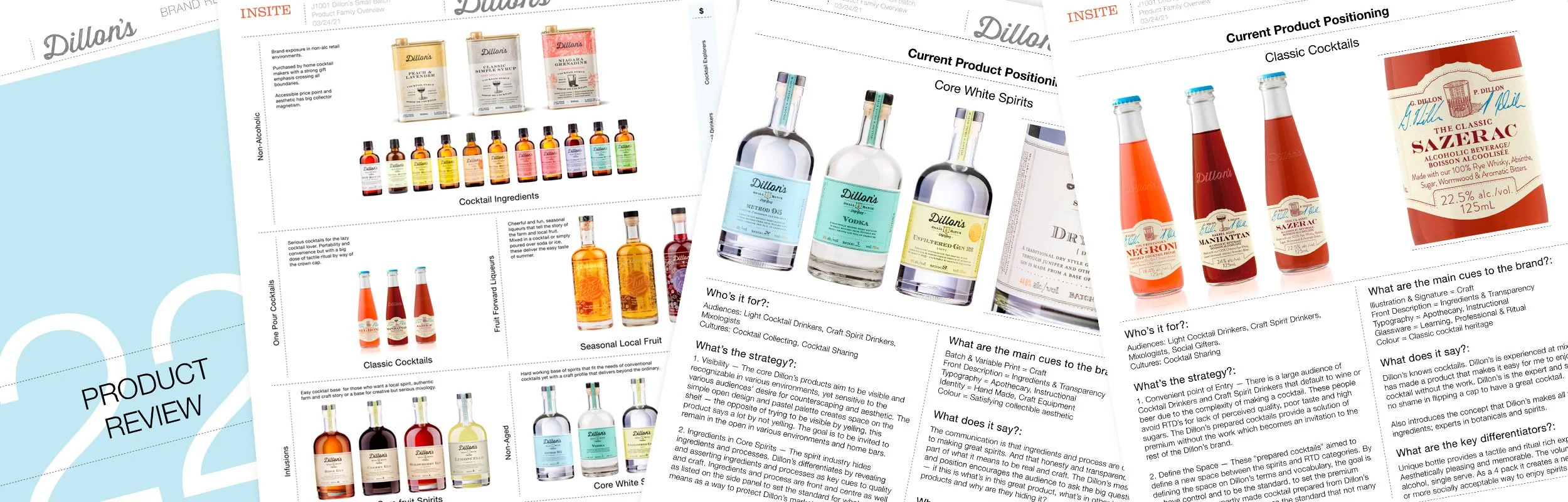
Dillon’s Small Batch Distillers product portfolio strategy & optimization
Nerd alert! This post gets geeky, but if you are in the alc./bev. industry, it’s for you.
Subject: Portfolio Organization & Optimization
One of the strategic ways we assist our alc./bev. clients is in organizing and optimizing their product portfolios. There’s a lot of depth to this but one cool part of the process is our attention to developing and attaching story to product tiers and the products themselves.
For wine, as an example, not only do we strategically sort the portfolio into tiers and practical sub-groups — such as by winemaking methods, price, varietals etc. — we also then define associated audience, purpose and key messages for each product group which needs to be conveyed. Doing this helps to make sense of the products to the audience and importantly, focuses your team — so that when the label designers, sales & marketing or social media content people are looking to tell the story of a particular wine — conveying why the product matters to the audience — they can start from the portfolio guide to direct them.
All this is to say that we ensure that each tier or grouping of products has an associated core brand message that is this tier’s/group’s job to tell. And if this story and pillar message doesn’t exist, we circle back into the brand's foundation, or even the business, and develop it. It’s an incredibly important and valuable process for any alcohol company, not just wine.
People, place and experience.
Now for a little more nerdery on stories.
When we build wine or alcohol brands from scratch, we ensure that the brand is built on a core set of brand pillars. And in conjunction with that we uncover or create a series of key relevant and valuable assets around which we build story. These assets are the brand’s people, place and experiences — it’s all audiences care about in terms of assets.
The people need to be those who are important to the brand such as with ownership, lead distillers with unique backstories or charismatic winemakers and chefs with values and methodology.
The place is interesting history connecting to community, or a special building with significance to the place, cool opinion rich spaces or even a unique natural feature on site.
And the experiences are unique activities that the people do to exemplify their craft in the making the product, or cool traditions that involve those most engaged, special ways to include the audience, gatherings that connect the people with the audience, demonstrations or ways to include the audience in production — all with the goal of being authentic and unique to the brand and goals for the product which then become important assets to the audience.
Then, we attach every wine tier & product group to the combination of brand pillar and asset and write associated rationale and story along with the purpose or benefit of the asset to the audience, thereby ensuring that the products become the vehicle for storytelling about the winery’s asset and core emotional value or pillar message.
The products become the vehicles for relaying physical and emotional assets — and trigger the audiences’ associated memory cues that help them recall key brand info and message — leading to brand uniqueness, learning and a deeper emotional value to them.
Phew.
So organizing portfolios is bigger than just an org chart.
If you think a Portfolio Strategy or Portfolio Optimization would be helpful for your brand, shoot us a note.
What we do — Mason Vineyard Case Brief
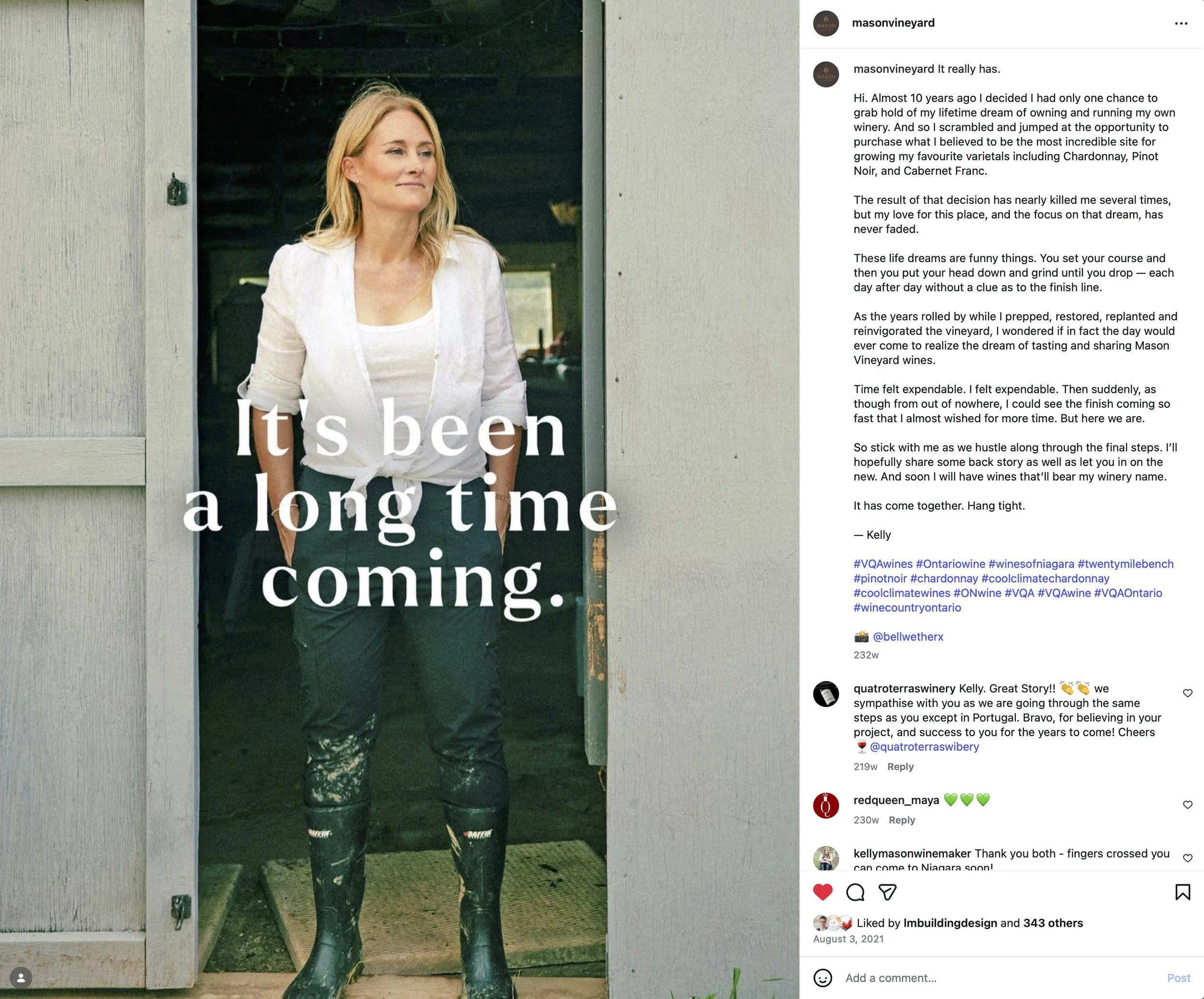
First Mason Vineyard Instagram Post in August 2021
What you don’t see
The reality of our business, this strategy and brand solutions gig, is that few people know what we do as a result of our work being mostly invisible.
Sure, you can thumb through our insta and web feeds to see familiar successful wine labels, delicious beer cans, progressive retail interiors, and loads of design work — but the larger extent of what we do is in the lead up to those designs, which you don’t see.
So if you have a moment, the following is a case study of one unique brand build and support contract. And I say unique because our solutions are always bespoke, tailored to suit each client's needs and challenges.
Project Case Overview
Client: Mason Vineyard
Scope: 3yr Contract / Strategy, brand and business development
Duration: 2021 through 2024
Challenges:
Break Norms: Startup winery needing to fast track the typical startup winery slow growth cycle
Business Efficiency: Mason was a self financed, founder operated business which meant resources were precious so the winery was needing faster than industry norm paths to: visibility and recognition, near instant ultra premium respect and trust, audience adoption without trial, ambitious year over year growing sales targets
Business Control: To become a healthy established winery by year 5 so as to be able to shift from startup development/implementation phase to on-strategy operation/refinement phase
Solutions:
Strong Foundation: Create a strategy and brand that would support the new top tier artisanal winery and its ultra-premium Canadian wine, and which would have the strength, trust and visibility of a successful 10th year brand almost right out of the gate
Be ‘truly’ well defined: Design a brand with a well defined compelling story from which to project a clear message, strong personality rich voice, well defined purpose with deftly aligned visual design and imagery so as to not waste time and energy clarifying and repeating weak or confusing messages
Business focused Brand: Present a magnetic brand which audiences could quickly relate to, adopt and become themselves ambassadors of
Insite’s Goals were achieved:
Anticipated and Planned: Developed and implemented strategy and process towards overcoming anticipated startup challenges
Strategic Releasing: Created strategy and implemented process for wine release launches with the goal met of selling out majority of wines within the first 60 days of release period
True Customer Management: Created strategy and implemented process for building an effectively segmented client allocation email database, from which majority of release volume was purchased
Considerate Customer Clienteling: Created strategy and process for a precise, on brand, repeatable, bare minimum communication and marketing system customized to 3 tiers of client relationships which facilitated successful sell-outs and consistent growth in the top most engaged tier as well constant increase in average spends
Lean Strategic Communication: Created a strategic on brand social media system that conserved resources by being strategically subject and message focused resulting in gaining 3k highly engaged and sales supportive social media followers who consistently purchased remaining cases available after initial email list allocation
Sales targets as solutions: Surpassed year over year increasing case sales goals, allowing introduction of special release projects beyond initial case volume targets
Sell-through as a brand strategy: Created strategy and implemented process for selling out each vintage before next release thereby avoiding aging inventory burden; storage costs, future labour and future marketing costs associated with marketing the same wine multiple times
Summary of achievements:
(inside our 3 year contract period)
Delivered strategy and brand that positioned winery as among best in class, helped attract national acclaim, gained passionate loyal following and built a reliable customer base that allowed the business to grow with confidence
Created strategy and process that lead to a healthy loyal repeating client list plus 3k social audience supporting 3 consecutive complete vintage sell-outs
Multiple highly regarded wine review coverage (both traditional and digital)
Best in class exposure with multiple National traditional media / magazine articles
So there you have it. That’s what we do behind the scenes and that’s what a successful strategy and brand build is about. If your business or brand can use strategic thinking, design, systems and execution, reach out.
Cheers
Emotional Value
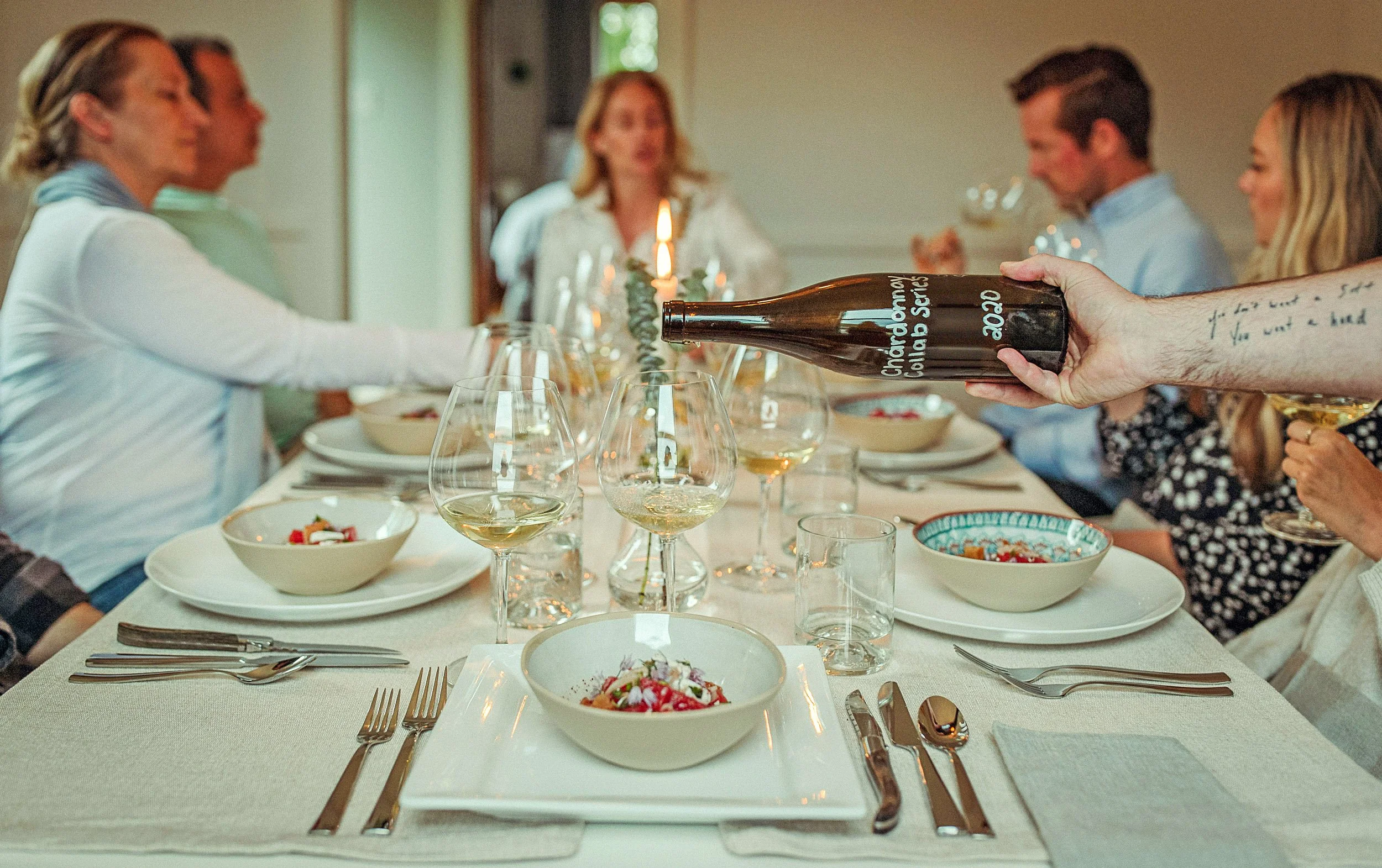
Mason Vineyard Enthusiasts Dinner
“The gap between perceived value and the true cost of doing business is becoming unmanageable”: Chef David Schwartz
A recent article in Toronto Life by Chef David Schwartz refreshingly sheds light on the plight of struggling restaurants in today’s challenging economy. The article concentrates on the idea of the decline of perceived value versus the actual rising costs of running a restaurant. Schwartz’s perspectives raise further conversation about why restaurants end up in their predicaments in the first place.
The answers lay in the Emotional Value delivered
In our perspective, when any consumer engaging in a premium or discretionary category like a restaurant or a winery experience complains about price and value, it’s rarely truly about price and generally because the business, product or restaurant failed to provide the expected or desired "emotional value” in return for the spend.
Emotional value is not portion size. But rather a non-comparable experience and emotional refill that leaves the audience feeling fulfilled, rewarded and needing more. Emotional value drives the need to be a part of what’s being offered so that the consumer or guest feels like their lives have been enriched and better off as a result of engaging in the product or experience.
In the case of restaurants, many need to do more in the offering of emotional value. Doing more doesn’t have to cost more. It just starts with the goal to recognize the needs and drivers of the guest and then to do better at delivering it. Clearer understanding, better preparation, more care and training and a genuine desire to do it well.
In general, audiences are a simple lot. We’re pretty much all the same and share similar needs and drivers. We desire, among other things, the following emotional value list:
to have fun, a good time, feel joy
to engage with uniqueness, so as to ourselves feel special and less like a number
to be around honesty, sincerity and authenticity
we need to assemble a sense of self identity through the people, ideas and material things we engage with or gather
we strive to earn the feeling of being attached, recognized, wanted, missed, valued
we like to learn and grow and have people respect our progress
we desire to build on our experiences toward feeling seasoned and sophisticated from this journey
many thrive to spend time in intentional and evocative spaces be they inspirational, emotional, stylish, warm and welcoming
we yearn to be inspired by the people behind the goods and experiences with their stories and craft
All of these things are valued much higher than money or the cost. It’s not unlike people's own work compensation — where employees will often take this list of needs above a pay raise. And consumers will always feel fulfilled when they attain this list despite a higher actual price compared to the competition.
Increase the Emotional Value or Perish
In our opinion, this is the basis of justified premiumization, where many brands and discretionary offerings have raised their prices in order to offer more enriching experiential relationships, craft and people while also improving their margins. In essence the higher price ecosystem supports the platform for the offering to be more about the list — a unique and enriching proposition that audiences find compelling and for which they’re willing to prioritize and shed less emotionally valued goods and services in their routines for higher emotional value alternatives.
Sadly though, what we see is that most restaurants are failing to deliver on justified premiumization wrapped around the list. Rather, they’re just raising their prices without improving their emotional value, and drifting into price sensitivity and pushback with their guests. The result, as well illustrated by Chef David Schwartz, is that restaurants then fall into the deadly tailspin of a price focused value engineering of the offering — a shrinkflation by cost cutting the experience, value pricing the menu, making the offering more "something for everyone" generic and ultimately becoming indistinguishable from the struggling pack.
Failing to back up price increases with care and attention to the emotional value list, restaurants and other offerings get relegated to the category of "poor value and not worth my time". During the slide, guests still go because they have no other choice. But eventually, when given the chance to change venues, they are quick to jump in hopes the next place will be different. Hence the popularity of the new restaurant up the street.
What’s on your brand’s Emotional Value List?
To better understand your super powers in how the emotional value list relates to your brand and offering, reach out and we’ll help you strategize, reveal and prioritize your emotional value.
Cheers
Know your emotional product
Hey businesses, do you know your “Product”?
Know your product. That’s what big talking sales managers and colourful retailers would say to trainees being indoctrinated into the traditional, material product oriented, supply chain and stuff on shelves retail. They’d tell you that the “product” was the stuff on the shelves and that the value to the “consumer” or end customer was in sales people being able to extol the difference between the various stuffs, and to get it off the shelf for them. So knowing every practical detail of that product was the key to selling it.
Then things got challenging.
Without getting into too much of the detail we all already know, a myriad of pressures on that traditional material product relationship eroded consumer’s confidence in this traditional system — it challenged our perspectives on value, relationship and trust. Without positive relationship and emotional value in the product purchasing equation, we became price conscious and subsequently drove that material product system into a race for the bottom where only big box material product retail could afford to exist.
But what if the material product wasn’t the actual product at all?
Perhaps the product, the reason for the purchase or the interaction between the customer and the retailer, was never the material product. What if a general laziness and lack of understanding of the emotional product among businesses removed the real emotional value out of the product exchange in the search for more margin.
And what they left was a skeleton of a product relationship — simply I’ll give you this in exchange for that money in your hand. No personal relationships, not conversation, no getting to know your name, no inspiration, no displays, no passion, no uniqueness, no image — no brand.
But what if the relationship was based on the emotional and not the practical? We believe it was, and still is. And we believe that successful businesses and retailers that have survived the pressures of the last few years get it. We believe that many new businesses and retailers that are starting up as flag bearers of the new economy get it. But unfortunately, so many still don’t.
So what is your real product?
I’ll tell you, it’s not the stuff on the shelves. Your product is the assembly of all your activities within your business but most critical is the emotional value elements of your proposition through to the experiences of engagement with you, all of which add up to be your brand. Essentially your product is your brand.
To break it down, your product is:
– your brand and identity embodied in action and the physical material product package
– the performance of or experience with your material product
– the culture cultivated within your audience
– your ability to inspire
– your physical presence, retail environment or experience area
– your social media presence and activities
– your design or curation of the products you make and stock
– your opinion or perspectives that influence the lifestyle of your company and offering
– your ability to create and support a culture around you
– the personal relationships you care to build with the people to whom you make or curate your goods or services for
– your reputation for discerning taste, quality and passion for service
– your demonstrated specialization and passion for the category of goods or services you offer
– your apparent care for doing things right; by quality, by designed spaces, by the wine served at functions to the cleanliness of the washrooms — if you care about this, it’s because you care about your customer and the culture you are a part of
This product is magnetic
When businesses get the product right. That is, to nail the list above, not as a mandatory checklist but in stride as part of the soul of the offering, they down right kill it and become magnetic.
But sadly, when businesses fail to see it, resist the list and continue to drag the traditional model across the new social society floor, they are rejected and replaced by the internet, or big box or swapped out for something completely different that will consume that slice of disposable income. It’s that easy.
Try it at home. Put on the lenses of this checklist and walk into a busy business or retailer and really look to see what’s happening. Is the place clean, well designed and comfortable? Does it inspire you? Are people hanging around, excited, voicing their enjoyment, laughing, engaging with staff and talking about their recent trip or family? Is this business successful? I’ll bet you answer yes.
Now go around the corner to that other shop. You know that quiet one with the poorly maintained backlit sign. Put on the lens and have a close look. What have they neglected on the list? What do they resist engaging in to their core. What do they resent about social media. Why don’t they host socials, events or workshops? What things do they not do better than big box retail, or restaurant chains, or other bakeries, or pubs or wineries? What do they stock that’s easily found on the internet? How are their prices because I know they have you checking? I’m sure they aren’t successful. They’re just hanging on.
New economy, new product
Quietly, but not without pain, the economy has been changing as has the business to consumer market place. Within the business to consumer relationship there has been a revolution to the point where you might even hear the term “Business or Retail 2.0″. It’s that big.
But inside this cliche is a reality that is overlooked, misunderstood or avoided as a hard uncomfortable truth. And that is that there is no longer a consumer. They are an audience. There are no longer products and retailers. Businesses are now performers. There is no longer a simple exchange. There is now a relationship. There is no longer a consumption, there is now engagement and lifestyle.
And what new 2.0 businesses innately offer is the lifestyle and not the material product. The material product is an excuse for the relationship. The material product or service is simply a category around which to build a culture. This new business engages in all that is the emotional product because they want to, not have to, and because it’s what interested them in the business in the first place. People are engaging in the florist that loves flowers and style, and lives and shares the lifestyle of flowers and entertaining, inviting you to join them. They don’t buy from the place that sells cheap flowers.
Know your real emotional product and offer all that surrounds it and the audience will take care of you.
– Barry
How to not fail — understand Brand
It’s easy and painless, you just gotta know it!
When we start a new relationship with a client, the first few conversations are almost always a calibration of communication where if people are going to understand us, and put up with our crazy talk for years to follow, they have to understand brand.
It is easily the most critical step for any person or company looking to communicate or market themselves or a product or service. Or for that matter, arguably, the growth and success of any idea in the public realm these days.
So, here are the steps to not fail at your business or communication goals:
1. Understand what is a brand?
No, it’s not that iron in the fire about to sear its logo to the back of your corporate pony. As Ted Mathews says — Brand, it ain’t the logo.
Brand is you. A brand is the perception people have of you. It’s what they think you are about — your motivations, values, actions, opinions. Your personal or product expressions, actions and engagements or experiences you create are how they build that perception. To build a brand is to engage in building an understanding of who you are by interaction and communication. A relationship is formed. Through consistent engagement grows a deeper understanding and a comfort and expectation of your brand.
2. Get to know you and your audience
To build a brand is to boil yourself down to the key, most critical emotional and physical value to your audience. Oh, yah that means you need to know your audience. Decide who they are and join them or be prepared to create a new culture and define a new audience — that works too. Either way, you need to tailor you and your product, to their needs and desires so figure out what that is.
Your material product is useless unless it fits your audience and cares about what they want. It has to resonate, be remarkable and emotionally useful. Folks don’t care if it has all the practical features in the world. If it doesn’t feel like it is directed at them, they’ll ignore it.
3. Create the Emotional Product
Just like the logo isn’t a brand, your product isn’t a physical thing on a shelf. Your product is you in action. Your product is everything you do that I can access, engage in, purchase, experience, talk about, build a lifestyle and self identity around. Your product is emotional value to me and is what I am willing to shell out for. Your emotional value is unique to me, without competition and to a large degree without a rational relative price. The physical or material product is merely an excuse for or a way to identify with the culture that you are participating in.
So figure out what your product really is. Boil it down and realize what the real base level value is to the audience and you will see so much of the point of what you are doing that you’ll be amazed. You’ll discover motivations and passions for the product that you had never considered.
4. Find your voice
What you say and how you say it is a metaphor for the product and the brand. But in a practical sense it’s how you’ll deliver the product and speak about it — distribution and communication. You may have heard that the medium is the message. That means the medium and the message is also the product. So deciding on how and where you’ll speak is critical in fine tuning the product to suit the audience.
Identify where you will be seen. Target experiences that will allow you to express yourself and engage with the right people and make a great impression. Learn to fit your voice to the audience but be remarkable, memorable, adding value to the room.
5. Wade in and be valuable content
Get going. There’s a lot to be said about good planning. But there’s a lot more to be said about timing and hard work. Be in the right place at the right time, or better, be first and build the right place, and work dam hard at building value and content in people’s lives and you’ll get there.
Then change the wheels on the bus while it’s moving. That is to learn on the run, build a team and adjust your brand and product as you go if need be. Just make sure you know yourself, your audience and the product or you can get lost.
6. How’s the water so far?
Look in the mirror. What do you see? The mirror incidentally is the market place. What are people saying or not saying — is the audience supporting you and saying what you hoped to hear, or is what they don’t say is revealing? How about the media — do they support or ignore you — they feed on good valuabe content so are you there in words or video? How do you reflect back to you? Do you like yourself? Is it a fit? Are you delivering what you promised — what you wanted to deliver?
You can be better. You love it so it’s not work to improve and do more. You just have to listen and all the answers are there.
Measure. Adjust. Wade back in. Repeat.
7. Write it down
Got it working? Realize what doesn’t? Think you know what’s next? Now right it down. Yep. Really successful brands spill it out. Get it out of your head on paper. Call it rough notes or an organized brand and product guide like the one’s we create — either way you will need a team to understand this brand, product and direction in order to keep going in a determined direction. It’s only fair to all involved. Good clear direction allows good people to help you.
Then keep this document open and adjust over time. It’s only paper. Good brands are flexible and evolve with the needs and culture of their audience. Even critical brands that seem to define their market and audiences quietly flex to adjust to trends and cultural influences.
You’re now an expert
Got it? Now make sure that everyone you work with — everybody in your camp gets it too. It’s critical. It’s difficult enough to run a company and manage the brand and product while battling adversity and market climactic changes. The last thing you need is to be working uphill against people on your team that don’t know brand — your brand. You cannot be constantly starting at square one as this is tedious, wastes resources and causes audience confusion — brand erosion.
Brand erosion is what we call it. We’ve all seen it. It’s where a new brand; a restaurant, product, place, shop, magazine makes such an amazing start and collects a huge following fast. They grow, add staff and product width and then you see it. Erosion of service. Thinning of the idea. Drying of the richness or dulling of the shine. The quality or passion falls out. The prices go up but the service doesn’t.
Why? Because someone, or a bunch of people in the organization don’t get it. It’s sometimes just a job. But often they aren’t indoctrinated like the first ones in were. They can’t understand the brand because they haven’t been trained. There isn’t a system in place for training on brand and so it falls apart, opportunities are missed, trends are avoided and the culture comes apart. Don’t make this mistake.
Make people read the notes. Encourage them to live with the audience and become a part of them. Help them find your original passion and excite them to take what you started further than you could have ever imagined.
— Barry
Your retail sucks — how-to fix it
Why your retail is sucking and what you need to do – asap.
Uncomfortable truth time. Most retail sucks. Said it! Most retail today is stuck in the past with retailers living a lie, believing that “consumers” need stuff and if they stand there long enough with stuff on the shelves, someone will buy it. Oh, and same goes for restaurants.
Put the gun down, let’s break this apart.
Typical, traditional retail brick and mortar is a concept. We’ll call it retail 1.0. The idea, though around for a long time, is simply posed as a place where people (retailers) have previously purchased products with the goal to sell a part of the whole again to an end user they perceive to need those goods.
These retailers buy from any number of sources, sometimes directly from manufacturers, often a middle wholesaler and at times from a central buying group with the intent to sell a portion of the products to the end user.
No matter what, it’s all the same — someone else is determining what goods are accessible to the retailer and the retailer grabs what suits their clientele and pays up front to put it on the shelf — to stock it. The consumer is then told it’s here (the promotion), now come buy it (the call to action!).
The problems
Here is the first issue with retail 1.0. Retailers still believe that the product is the stuff on the shelves. They believe that’s what people actually want and so the activities of retail — all the actions that get the product in and out the door — are centric around finding product, stocking, tracking, placing on the shelf, beautifying the store and arrangements of products, promoting the stuff and assisting the consumer in getting it out the door. Job done. Retailer now exhausted.
But, whoa wait. What if people — consumers — don’t really need anything but sustenance; love, air food and water? What if the treadmill of getting off the sofa and heading across town to purchase that thing is the most tedious, grudge-worthy waste of time in anyone’s day? And, what if there were an alternative? Such as:
A. not buying that thing or
B. purchasing that thing from the internet and having it shipped
Well guess what? Both alternatives are real. And both alternatives are obliterating retail at such a rate that the retail landscape is in cardiac arrest.
Aging demographics are concluding that their fixed income future is uncertain so to remain practical they are just going without at the same time the 25 to 35 y’old newcomers have concluded that there is only so much squeeze in their shrinking incomes, space in their tiny apartments and only so much they can carry on their bicycle anyway so they are saying no or turning their spending toward experiences.
When people actually need stuff, “consumers” are concluding that most retail is so practical and boring that the cost of shipping from online purchasing is worth it so that they can stay on the couch and hit continue on their PS3 — and by the way the cost of shipping is shrinking due to lower fuel costs.
But, but, but — it doesn’t have to be this way.
There are successes
In fact, there are entire categories of successes. You see them everyday. You likely participate in them, get excited about them or are even jealous of their magic. But wait, it’s not magic, they are just awesome. Really though, they see the light of retail 2.0.
The successful retailers today know what people want and they know what the product really is. Successful retailers are more conscious of providing what their audiences desire than sourcing deals on products they can get their hands on. They look out, rather than in. Are gracious, rather than selfish.
What retailer 2.0 knows is that the real product is not the goods. Don’t get me wrong, the goods have gotta be good, but it’s not what people get off the couch for. Audiences desire more emotional relationships and respond to offerings that fulfil challenges and needs in their life such as cutting through complexity, offers of a sense of well being or richer lifestyle, fulfilment of the desire to belong, be understood or understand one’s self. The feeling that they have done a good thing, helped someone or had a mutual respectful exchange of needs is fuel. Deep stuff huh? Yep.
In action though it’s really clear. Take your awesome little coffee shop around the corner. If you don’t go to one, start now and if you don’t want to than we can’t help you.
That little shop likely makes dam good hand massaged, locally roasted, fair trade organic earth loving black goodness. It has to. But that’s not why folks fall in love with the place and return multiple times a day. People go because the place remembers them. Oh, and the other customers remember them too. The place inspires and hosts conversations. The place introduces ideas such as new music, fresh style, emerging trends, learnings about coffee and techniques, likely hosts events, fun evenings, workshops, cool singers, artists and — hold on — rich culture.
How do you sell culture you ask? Where’s the return on that? Don’t worry — provide rich culture and people will reimburse you by purchasing practically anything you have in stock just to feel as though they have rewarded your effort so that we can all do this again. A fair exchange.
So let’s review. I create an enjoyable environment for people to engage in a rich culture, I hire nice staff to build relationships, remember names, start conversations, play great music, introduce new ideas, invite art and source and offer inspiring goods and this is what the product actually is? Yes.
Today’s successful retailers are selling a new emotional idea and have changed the model. They offer among many rich emotional ideas:
Trust, Curation and filtering – cutting through the complex world to offer the quality discernment, keen eye and style of the owners and staff
Inspiration and education – beautiful idea displays and uses of the products, workshops and demonstrations
Lifestyle and entertainment – music, dinners, evening gatherings
Relationship and belonging – social recognition and sharing, mutual respect and reliance, association, club or group
Emotional fulfilment and Self identity – personal satisfaction and altruism, feeling like the place is part of who I am
And though the structure in which they do this feels to some degree the same as the old, it won’t be long until 2.1 brings a whole new infrastructure and re-arrangement of place.
For example, look at the subtle changes in retailing; displays, signage, POS systems and the placement of the cash area. Where cash registers/checkouts used to dominate the entrance/exit areas, payment areas are now shrinking and falling toward the centre or rear, allowing for more flexible event and social spaces, lounges, culture room and inspiration. POS itself is becoming streamlined and if you squint just right, are almost gone, soon to be replaced by transparent transaction systems.
The new emotional offering means a critical reduction or shift in the practical mindset toward the emotional side of the brain. Price cards are disappearing and are replaced by education and inspiration. References to prices, returns, warrantees, specials and sales are wiped away so as to not kill the emotional buzz of the lifestyle visitor — keeping them from shifting from thinking with their Emotional Me, to being controlled by their rational practical stingy wallet.
Keeping you from thinking about your wallet means you can dream, loose track of time and not connect your cheap ass practical side of your brain to the fun self indulging experiential brain you are listening to.
As successful retailers continue to see the gains from creating positive enriching experiences, building cultures around their brands and programming new ways to fulfil the deep emotional product, we’ll see a complete re-imagining of the retail space.
Can’t buy that online
So hopefully we can all now agree that the product people really want is emotional. We see it everyday and know how dam compelling it can be. The beauty of this emotional product is that for now you simply can’t buy it online. Sure, you can still get most of anything retail 2.0 offers in a practical material product sense. In fact, most 2.0 retailers offer their goods online and do a remarkable job of hosting their culture in that space too. But it’s not the same.
The audience wants the emotional — they want it from a physical place with real staff and like minded others with whom they can feel like a tribe. The key is that audiences only have so much disposable income to blow on stuff so the goods they acquire through the emotional purchase will supersede desire for any practical needs based acquisition. Further, when audiences are out of disposable cash, their desire to remain engaged in your “product” remains so by fulfilling this desire with engaging experiences; workshops, events, social offerings and culture without high cost barriers ensure that people will remain loyal with you top of mind.
Retail 2.0 is here, healthy and eating your lunch. The choice is yours as a retailer — understand the emotional product and cultivate it or fight your way to the bottom along with failing commodity price based retailers and online discounters.
— Barry
Is your Emotional Product Score helping or hurting you?
What’s your emotional value?
Emotional Value = Price weighed against emotional product score
We’re of the belief that audiences are tough-ass judges. No matter who you are, what you do, how nice you are, you are being judged good or bad. For most of us, this is inconsequential in the grand scheme of things as we don’t base our livelihood on promises and time can be very forgiving.
However, for businesses, especially those on the front lines of consumer offerings and dishing up product promises, time is of the essence so it’s critical to be judged on the high side of the sum of an emotional checklist weighed against the price of the experience. We call this the emotional value score.
Audiences subconsciously carry this emotional checklist of various categories that they weigh you against. At first interaction, the cross check is coarse, blunt and general — where audiences simply rate you with a good or bad through the list. If you have it – you get a good or a 1. Don’t have it, then a bad or a 0. If you score above middle then you get a second chance but if you don’t, then they move on, possibly forever.
If you are lucky enough to get a second chance, then things adjust. Audiences get more sensitive, spending more time to really gauge the nuances of your offering to see if they will come again as well as move in emotionally for the long term. The audience begins to weigh the list as it relates to them but also to your basic promise or proposition. They make excuses for bad scores and can become more forgiving, as long as you can deliver above average or better yet, you are showing improvement.
Hey, this is no different then any personal relationship. It takes time. You work at it, you sometimes get second chances but you can never take the other for granted and you must always score higher than middle, and continue to score higher, on the emotional value score.
The Emotional Product List
All offerings break down into, among many things, these heavier emotional categories:
People — Treatment & relationships, culture & scene, personality and charisma, knowledgeable
Place & Spatial Environment — Beauty or awe of Land, aesthetic of a place, Interior inspiration, comfort, style, music
Experience — Enjoyment, entertainment, fun, learning, ease, time spent
Care — Thoughtfulness of design, Cleanliness and Pride, graciousness, attention to detail, passion
Quality (of “Product”) — Perceived quality of performance or Taste of Material Product or Food
Uniqueness — Perceived uniqueness of product and differentiation from the heap that allows people to remember — ask your self, “are you extraordinary?”
Fit & Relevance — Compatibility with audience’s lives in a emotional, practical use and technical perspective
Every time someone interacts with your product offering, they subconsciously re-score and decide if they need to do it again or take some time off — consciously-uncouple! This score is then often immediately communicated to friends or social extensions (social media) as storytelling or content by way of a summary of the highest weighted importance or argument to justify the conclusion they are summarizing.
“…just had the best coffee ever at Justa Bean again. Wow they know their stuff and now I don’t even need to tell them what I want…” “love the music they play there, I always come away with a new band to check out…” — Score: relationship, inspiration, learning, care, quality, relevance = 6 out of 7
In some cases, offerings fail miserably in a few categories, yet they still do well and audiences defend them.
“…had dinner at Snarky Dogs last night. Dam that place was dirty but how cool were the staff, and you have to try the burger — it’s killer and was just $25. BTW they have tons of local draft beer too.”
In this case the personal weight of pride and space scored low yet people, quality and uniqueness and fit added up to make a great experience that overcame the downside — so 4/7 = good emotional product and when weighted against the perceived low price point = good emotional value.
Be Strategic
So strategically you might consider that though the list seems evenly weighted and attainable for a business offering to score a decent average across all points, perhaps being really awesome in a couple of key categories while not so good in a couple others is better than just ok at all of them.
Perhaps the ones you can be really good at are your Promise and the points you are going to suck at are a part of your texture and personality; the things people see as funny, risky, memorable or hope to see evolve.
Being ok at all things may be a little boring and certainly isn’t a standout. For some brands this is ok to be that safe fall back. There is honour there for sure. But it may be a fragile position because the world doesn’t stand still. Things move fast around here and it won’t be long before good isn’t good enough as others in your competitive hood have raised the bar, or trends simply change affecting audiences’ desires for uniqueness, possibly leaning them toward riskier, trendier, more exciting brands. Sorry old man.
The promise
Remembering that your real product is emotional, not physical, you have to decide what you are good at and what you can consistently, confidently, deliver. This should be your promise — your offering and proposition.
Picking what’s achievable, recognizing what’s not, and then building this into the product promise is a realistic way of ensuring you can fulfil your obligation to not under deliver. You simply must match the promise with the delivery or you will fail and spend a whack of dough in the process.
You can also set the weight, emphasis, confidence and tone of the delivery of the checklist — essentially establishing personality and expectation around the promise. Assert what’s most important and confidently dismiss what’s not — what you aren’t good at — and people will get it as long as you are consistent.
One of my favourite pizza restaurants has from day one stated it doesn’t cut your pizza or pit the olives. So don’t ask. This establishes the limit of their customer service position — saying simply, “we are confident that making great food in a cool environment with a good culture is enough — we’re not servants, we don’t cater to special interests — so cut your own dam pizza”.
Being confident with who you are and delivering consistently helps you build a culture of understanding and anticipation of your brand among your audience and staff. Once this is in place, they’ll do the work of carrying the brand.
Honesty is the best policy
Tough love time. Run through the list and ask yourself how you score. Aha, take off the rose coloured glasses. Then ask some of your audience, customers and friends how you score. Be honest, it won’t hurt, besides if your brand is weak and product popularity is waining, you are already in pain.
If you score 50/50 or less then you have to get better at a couple of things and begin to confidently assert that the other things just aren’t, your thing. You can do it!
If you score 70/30 you are in a great spot so now begin to hit the high notes, the things you really love, even higher. Get really good at them, talk about them, build the offering into your position statement and build your culture on it. Then protect your position by confidently admitting what you don’t do and eventually you might find that this becomes less important to audiences, and therefore less of a competitive edge for other brands that can deliver on this note.
Steam Whistle, a Toronto brewery that had aspirations to be a successful brewery beyond small production craft, is located in a small swatch of a property with big rent in the downtown entertainment district. What they did well was make a good all round pilsner beer in a steampunk cool facility.
What they couldn’t do well was make a variety pack of beers due to the associated challenges of managing the logistics of variety at their location. So confidently they sewed their lack of variety weakness into their brand and product offering — “Do one thing, really, really well.” — and with it created personality, differentiation and a clear deliverable promise.
Apple Computer, that small upstart from California made well designed desktop computers of exceptional detail, high aesthetic, longevity and stability. Due to financing and production constraints as well as high standards for internal component cross-compatibity and reliability, they couldn’t provide product variety or open source operating system access — attributes dominated by their main competition. What Apple could deliver on was done so with confidence and consistency — asserting their pros and being really good at them. Fast track 30 years and the general audience no longer cares about the practical attributes of product variety or open source software. But they certainly appreciate the emotional quality, reliability, good design and inspiration.
Be consistent
The key in any scenario of emotional value is to learn to be consistent because that means reliability. People always return to reliable even if you are reliably bad in a few categories. If you aren’t currently consistent, then you simply have to fix that today. Identify the reason you aren’t consistent — staffing, ingredients, materials, culture, cleaning — all just variables that you can identify and control. Starting now.
— Barry